
You are allowed to grow at your own pace- you needed to read that sentence again, let it sink. In a world driven by comparison, timelines, and the pressure to have everything figured out by a certain age, many believers are walking around with a quiet sense of failure. Failure for not being further ahead in their career. Failure for not being married yet. Failure for still struggling with the same sin. Failure for not being as spiritually mature as the person next to them in the pew. HOW TO HEAR GOD’S VOICE IN A NOISY WORLD https://pcainspires.com.ng/how-to-hear-gods-voice-in-a-noisy-world/ But what if God never asked you to match someone else’s pace? What if your season is not delayed – it is just different? This post is a faith-based reminder that growing at your own pace is not only acceptable, it is often exactly how God designed your journey. The Comparison Trap That Steals Your Peace One of the enemy’s most effective tools against believers is comparison. Social media has amplified this to dangerous levels. You scroll through Instagram and see someone your age getting promoted, getting married, starting a ministry, traveling the world and suddenly your own life feels insufficient. But here is the truth: you are seeing their highlight reel, not their full story. You do not see the tears behind the announcement, the years of struggle before the breakthrough, the private battles that preceded the public victory. When you compare your chapter three to someone else’s chapter twenty, you will always come up short, not because you are behind, but because you are comparing incorrectly. Growing at your own pace means trusting that God knows exactly where you are in your story and is not rushing you past the lessons you still need to learn. God Does Not Work with a Human Timeline https://www.bing.com/ck/a?!&&p=dfc5bfd82f62f7e3652ef26d55a10d504b9afadd315a1b02501ea8e32be32558JmltdHM9MTc4ODIyMDgwMA&ptn=3&ver=2&hsh=4&fclid=2366de9e-d8c2-672b-1ff2-cbe9d9766668&psq=YOU+ARE+ALLOWED+TO+GROW+AT+YOUR+OWN+PACE&u=a1aHR0cHM6Ly9wb3NpdGl2aXR5Lm9yZy9hZmZpcm1hdGlvbnMvYWxsb3cteW91cnNlbGYtdG8tZ3Jvdy1hdC15b3VyLW93bi1wYWNlLXRoZS1nZW50bGUtYXJ0LW9mLWJlY29taW5n The Bible is full of people who grew at their own pace by the world’s standards. Moses was 80 years old when God called him to lead a nation. Abraham waited 25 years for the promised son. Joseph spent years in a pit and a prison before reaching the palace. Mary was an obscure teenager in a small town when God chose her to carry the Savior. None of these people were on a conventional timeline. None of them could have predicted when or how their breakthrough would come. But all of them had one thing in common: they stayed faithful in the season they were in, and God moved at exactly the right moment. Your growth at your own pace is not a mistake in God’s plan; it IS the plan. What Growing at Your Own Pace Really Looks Like Growing at your own pace does not mean being passive or complacent. It does not mean using “my season” as an excuse to avoid responsibility, growth, or hard work. It means something beautifully different: It means being faithful where you are, instead of anxious about where you are not. It means learning the lessons of this season thoroughly, rather than rushing past them to get to the next stage. It means trusting God’s timing more than cultural pressure or social media trends. WHAT DOES IT MEAN TO BE BORN AGAIN? A SIMPLE EXPLANATION https://pcainspires.com.ng/what-does-it-mean-to-be-born-again/ It means being honest about where you are in your journey, not performing an advanced level of faith or maturity that you have not yet developed. Authenticity in your pace is actually a form of spiritual integrity. Give Yourself Permission to Be a Work in Progress Philippians 1:6 says, “He who began a good work in you will carry it on to completion until the day of Christ Jesus.” Notice what this verse tells us: the work is not finished yet. You are still being worked on. That means imperfection, growth, setbacks, and steady progress are all part of the process. You are allowed to grow at your own pace because you are a work in progress. A building under construction looks messy and incomplete. But the builder is not alarmed, he knows what the finished structure will look like. God, who is your builder, is not alarmed by your current state. He sees the finished version of you. Stop Apologizing for Your Season There is an unspoken pressure in Christian circles to appear further along than you are. People announce breakthroughs before they have fully arrived. They use spiritual language that masks real struggles. They compare testimonies and feel inadequate when theirs seems smaller or slower. But growing at your own pace means owning your season without shame. If you are in a wilderness season, say so, at least to God and trusted community. If you are still working through the same issue you were dealing with two years ago, be honest about it. God meets you in your honesty far more readily than in your performance. Encouragement for Whoever Needs This Today BIOGRAPHY OF MERCY CHINWO: THE VOICE GOD GAVE NIGERIA https://pcainspires.com.ng/biography-of-mercy-chinwo-the-voice-god-gave-nigeria/ You are not behind. You are not forgotten. You are not a disappointment to God. You are exactly where He can work with you most effectively right now. The pace of your growth is not evidence of God’s absence it is evidence of His patience and His precision. Ecclesiastes 3:1 says, “There is a time for everything and a season for every activity under the heavens.” Your time is coming. Your season is not lost. Keep tending to what God has given you today, and trust Him with what He has planned for tomorrow. THOUGHT. You are allowed to grow at your own pace. Say it again. You are allowed to grow at your own pace. Release the comparison. Release the pressure. Release the false timeline. You were not designed to be anyone else’s copy, you were designed to be the fullest version of yourself, developed on God’s perfect schedule. Keep going. Keep growing. And trust the God who never rushes but is always on time. 📌 Related Posts You Will Love: → 7 Bible

HOW TO HEAR GOD’S VOICE IN A NOISY WORLD
How to hear God’s voice in a noisy world is one of the greatest spiritual challenges facing believers in this generation. We live in an era of constant noise; notifications pinging on our phones, social media competing for every spare moment, news cycles designed to keep us anxious, and the daily demands of work and family filling every corner of our mental space. In the middle of all this, many Christians are crying out: “God, are You speaking? Because I cannot hear You.” WHAT DOES IT MEAN TO BE BORN AGAIN? A SIMPLE EXPLANATION https://pcainspires.com.ng/what-does-it-mean-to-be-born-again/ The good news is that God is still speaking. He has never stopped. The problem is rarely that God is silent, the problem is that we have not learned how to create the conditions in which we can hear His voice clearly. This post will give you practical, biblical tools to do exactly that. Why It Is Hard to Hear God’s Voice Today Before we explore how to hear God’s voice, it helps to understand why it is difficult. Jesus described Himself as a shepherd whose sheep know His voice (John 10:27). But even sheep can be confused by too much noise in the environment. The modern world creates several barriers to hearing God’s voice: Digital overstimulation: The average person checks their phone over 150 times a day. This constant input trains our minds to be always receiving external information and rarely pausing to listen inwardly. Busyness as a value: Our culture praises the busy and productive. Stillness is often mistaken for laziness. But God speaks in the still, small voice and you cannot hear a still, small voice if you are always rushing. Spiritual dullness: Unconfessed sin, unresolved bitterness, and prolonged spiritual neglect can create a kind of static that makes hearing God’s voice more difficult. 1. Slow Down and Create Silence to Hear God’s Voice https://www.bing.com/ck/a?!&&p=c55f508cab9211f1c632fbdc61acabd46f54ad95551e5aed046a7acaadca617bJmltdHM9MTc4ODIyMDgwMA&ptn=3&ver=2&hsh=4&fclid=2366de9e-d8c2-672b-1ff2-cbe9d9766668&psq=HOW+TO+HEAR+GOD%27S+VOICE&u=a1aHR0cHM6Ly93d3cua2NtLm9yZy9oZWFyaW5nLWdvZC9ob3ctdG8taGVhci1nb2RzLXZvaWNlLTUtYmlibGljYWwtd2F5cy10by1yZWNvZ25pemUtYW5kLXJlc3BvbmQv The first and most fundamental step in learning how to hear God’s voice is intentional silence. Psalm 46:10 says, “Be still and know that I am God.” This is not optional advice; it is a spiritual command. You cannot hear a whisper in a hurricane. You must first slow down. Set aside at least 15-20 minutes daily where you put away your phone, sit in silence, and simply wait on God. This may feel uncomfortable at first. Your mind will race. But with consistency, you will begin to notice impressions, thoughts, and nudges that carry a distinct weight and peace; these are often the ways God’s voice communicates. BIOGRAPHY OF MERCY CHINWO: THE VOICE GOD GAVE NIGERIA https://pcainspires.com.ng/biography-of-mercy-chinwo-the-voice-god-gave-nigeria/ 2. Study the Bible to Recognize God’s Voice One of the most reliable ways to hear God’s voice is through His written Word. The Bible is the foundation of all hearing because God will never speak to you in ways that contradict what He has already said in Scripture. The more you know the Word, the more easily you recognize God’s voice when He speaks. John 10:27 says, “My sheep listen to my voice; I know them, and they follow me.” Sheep recognize their shepherd’s voice because they have spent time with him. Spend time in the Word daily, and over time, God’s voice will become familiar and recognizable. 3. Pray in a Conversational Way Many Christians approach prayer as a monologue, a list of requests delivered to God. But hearing God’s voice requires prayer to be a dialogue. Speak to God, then pause and listen. Ask Him a question, then sit quietly and wait for a response. This kind of conversational prayer may feel strange at first, especially if you were trained to fill every prayer moment with words. But learning to be comfortable in the silence of prayer is where you begin to hear God’s voice most clearly. 4. Pay Attention to the Holy Spirit’s Promptings God’s voice often comes as a gentle prompting of the Holy Spirit not an audible voice, but an inner knowing, a persistent thought, a sudden peace about a decision, or an unexpected concern for someone. Romans 8:16 says, “The Spirit himself testifies with our spirit.” To hear God’s voice through the Spirit, you must pay attention to these inner promptings and test them against Scripture. If a prompting leads you toward love, truth, righteousness, and the fruit of the Spirit, it is likely God’s voice. If it leads to fear, pride, or sin, it is not. 5. Fast to Sharpen Your Spiritual Sensitivity Fasting is one of the most powerful but underused tools for hearing God’s voice. When you fast, you are voluntarily removing a physical comfort in order to deepen your spiritual focus. The noise of appetite is silenced, and your spirit becomes more sensitive to God’s voice. Many believers have testified that their clearest experiences of hearing God’s voice came during fasting. Start with a simple one-day fast once a week and pay close attention to what God brings to your attention during that time. 6. Keep a Spiritual Journal Writing down what you sense God saying is a powerful way to develop your ability to hear God’s voice over time. When you journal your prayers, your impressions, and what you sense God communicating and then look back over weeks and months you will see patterns that confirm His voice. You will notice when what you sensed came to pass. You will see recurring themes that are clearly God directing your attention to specific areas of your life. A spiritual journal also helps you distinguish between God’s voice, your own thoughts, and other influences. 7. Obey What You Have Already Heard One of the most overlooked principles for hearing God’s voice more clearly is obeying what He has already spoken. If God told you to forgive someone and you have not done it, it becomes much harder to hear His next word. Disobedience creates spiritual static. Luke 16:10 says that whoever is faithful in little will be faithful in much. As you obey the smaller promptings; to reach
WHAT DOES IT MEAN TO BE BORN AGAIN? A SIMPLE EXPLANATION
What does it mean to be born again is one of the most important questions any person can ask in their lifetime. The phrase “born again” appears in churches, on social media, in conversations, and in the Bible, but many people, including longtime churchgoers, are not entirely sure what it truly means. Today, we are going to break it down in the simplest way possible. If you have ever wondered whether you are truly born again, or if you have been curious about what happens when someone gives their life to Christ, this post is for you. Let us explore what the Bible says about being born again and why it matters for your eternal life. Where Did “Born Again” Come From? The phrase “born again” comes directly from a conversation Jesus had with a religious leader named Nicodemus in John 3:1-8. Nicodemus came to Jesus at night; a powerful, respected man who wanted to understand Jesus’s teachings. Jesus said something that stopped him completely: “Very truly I tell you, no one can see the kingdom of God unless they are born again.” – John 3:3 Nicodemus was confused. He asked, “How can someone be born when they are old? Surely they cannot enter a second time into their mother’s womb to be born” But Jesus was not talking about a physical birth. He was talking about a spiritual transformation. Understanding what it means to be born again begins with understanding that it is a spiritual, not physical, event. What Does It Mean to Be Born Again Spiritually? To understand what it means to be born again, we need to understand the human condition. The Bible tells us that all people are born into sin, separated from God because of the sinful nature we inherited (Romans 3:23). This spiritual separation means that without intervention, we cannot have a relationship with God. Being born again means that through faith in Jesus Christ, your spiritual nature is completely transformed. The old sinful self – with its spiritual deadness is replaced by a new nature that is alive to God. 2 Corinthians 5:17 says, “Therefore, if anyone is in Christ, the new creation has come: the old has gone, the new is here” This is what it means to be born again: you become a new creation. Not just a better version of yourself, a completely new spiritual being, with a new relationship with God, a new purpose, and a new eternal destination. How Does Someone Become Born Again? Many people wonder exactly how being born again happens. The process is beautifully simple, and yet profoundly life-changing: https://www.bing.com/ck/a?!&&p=eb49a8c446f5b1025ee2e3ed3d75eaaa6f8007f39aa8901a75906199ed21ddfeJmltdHM9MTc4ODIyMDgwMA&ptn=3&ver=2&hsh=4&fclid=2366de9e-d8c2-672b-1ff2-cbe9d9766668&psq=what+does+it+mean+to+be+born+again&u=a1aHR0cHM6Ly93d3cuZ290cXVlc3Rpb25zLm9yZy9ib3JuLWFnYWluLmh0bWw Step 1 – Acknowledge: Recognize that you are a sinner in need of a Savior. Romans 3:23 says all have sinned and fall short of the glory of God. Step 2 – Believe: Believe that Jesus Christ died for your sins, was buried, and rose again on the third day (1 Corinthians 15:3-4). He took the punishment for your sin so you would not have to. Step 3 – Confess: Confess Jesus as Lord over your life. Romans 10:9 says, “If you declare with your mouth, Jesus is Lord, and believe in your heart that God raised him from the dead, you will be saved.” Step 4 – Surrender: Make a genuine decision to turn away from your old life and follow Christ. This is called repentance a complete change of direction. When these steps happen with genuine faith and sincerity of heart you are born again. It is not about saying magic words or completing a ritual. It is about a real encounter with the living God that transforms you from the inside out. What Changes When You Are Born Again? Understanding what it means to be born again also involves understanding what changes afterward. Being born again is not the end of the journey it is the beginning. Your spirit comes alive: Before being born again, you were spiritually dead. Afterward, your spirit is alive to God, you can sense His presence, hear His voice, and communicate with Him in prayer. You receive the Holy Spirit: John 14:16-17 tells us that when you receive Christ, the Holy Spirit comes to live inside you. He guides, comforts, teaches, and empowers you. Your desires begin to change: You may notice a growing hunger for the Word of God, a discomfort with sin, a desire to pray, and a love for other believers. These are signs of the new nature at work. You receive eternal life: Perhaps the most profound change, being born again gives you the gift of eternal life. John 3:16 tells us, “For God so loved the world that He gave His one and only Son, that whoever believes in Him shall not perish but have eternal life.” Are You Born Again? If you have read this post and realized you have never truly surrendered your life to Christ, today is your day. You can be born again right now, wherever you are. You do not need a church building or a pastor present, you just need a sincere heart. Pray this simple prayer: “Lord Jesus, I acknowledge that I am a sinner. I believe You died for my sins and rose again. I confess You as Lord of my life. I turn away from my old way of living and choose to follow You. Thank You for saving me. I am born again. Amen.” If you prayed that prayer sincerely, welcome to the family of God. You are born again. Now find a Bible-believing church, begin reading your Bible, and start your new life in Christ. THOUGHT. What does it mean to be born again? It means starting over – spiritually – with God as your Father, Christ as your Savior, and the Holy Spirit as your guide. It is the most important decision any human being can make, and it has eternal consequences. Do not delay. God is waiting with open arms. 📌 Related Posts You Will Love: → The

BIOGRAPHY OF MERCY CHINWO: THE VOICE GOD GAVE NIGERIA
Biography of Mercy Chinwo is the story of hope, consistency, helped and grace, she is not just a gospel artist, she is a vessel. A voice that God specifically shaped, tested, and released into a generation hungry for authentic worship in Africa and continents far beyond. She gained recognition after winning the second season of Nigerian Idol, and decided to pursue a career in gospel music. Mercy Nnenda Chinwo was born on 5 September 1990, in Rivers State, Nigeria. She started singing in the children’s choir at her church when she was six years old. Chinwo earned a certificate while attending the Goodwill International School, and did her secondary education at Paradise International School. She is an alumna of the International Business Management Institute (IBMI), where she earned a degree in human resource management. If you have ever played “Excess Love,” “Omekannaya,” or “Chinedum” on repeat and found yourself weeping in worship, then you already know what makes the biography of Mercy Chinwo so extraordinary. Her music does not just entertain; it ministers. 5 DAILY HABITS OF SPIRITUALLY STRONG PEOPLE https://pcainspires.com.ng/5-daily-habits-of-spiritually-strong-people/ Early Life and Background of Mercy Chinwo The biography of Mercy Chinwo begins in a family rooted in faith. She grew up in a Christian home in Rivers, Port Harcourt, where music and church were central to daily life. From a young age, Mercy showed a natural gift for music, singing in her local church and school. But it was not talent alone that set her apart, it was the evident anointing that accompanied her voice even as a child. https://www.bing.com/ck/a?!&&p=3d599b23174d939065f79859aed28c5e69dc4876c8018f33db68a746244fade7JmltdHM9MTc4ODEzNDQwMA&ptn=3&ver=2&hsh=4&fclid=2366de9e-d8c2-672b-1ff2-cbe9d9766668&psq=mercy+chinwo+has+how+many+children+currently&u=a1aHR0cHM6Ly9nb3NwZWxjcmliLmNvbS5uZy8yMDI2LzA3LzIxL21lcmN5LWNoaW53by1iaW9ncmFwaHktYmFja2dyb3VuZC1hZ2UtaHVzYmFuZC1jaGlsZHJlbi1lZHVjYXRpb24tbWluaXN0cnktYW5kLXNwaXJpdHVhbC1mYXRoZXIv Even in those early years, those who heard her sing knew something special was present. Mercy herself has spoken in several interviews about how her faith was foundational from childhood, not just religion, but a genuine personal relationship with God. Mercy Chinwo’s Rise to Fame, The Nigerian Idol Journey The biography of Mercy Chinwo took a significant turn in 2012 when she participated in the Nigerian Idol Season 2, a popular music competition. Mercy made it to the finals and won the competition, becoming a household name in Nigeria overnight. Her voice, her humility, and her consistent faith throughout the competition endeared her to millions of viewers. However, unlike many reality TV winners who transition into secular music, Mercy Chinwo made a deliberate and courageous decision. She chose to dedicate her gift entirely to gospel music. At a time when secular music offered more visibility and financial reward, she chose the Kingdom and God honored that choice beyond anything she could have imagined. The Music Ministry of Mercy Chinwo The biography of Mercy Chinwo in gospel music is a catalogue of anointed, Spirit-filled songs that have blessed millions. Her debut album, “Satisfied,” released in 2017, introduced the world to her extraordinary gift. Songs like “Excess Love,” “Better,” and “You Are God” became worship anthems in churches across Nigeria and the diaspora. Her second album, “The Cross: My Gaze,” released in 2019, further cemented her place as one of Africa’s most influential gospel voices. The album contained the mega-hit “Omekannaya” a song that trended across social media platforms and became a staple at Nigerian weddings, church services, and prayer meetings. Songs from the biography of Mercy Chinwo’s music journey have been used in hospitals to comfort patients, in prayer rooms to break spiritual barriers, and in moments of personal grief to bring peace. That is the measure of true gospel music when it ministers beyond the stage. Awards and Recognition in Mercy Chinwo’s Biography The biography of Mercy Chinwo is decorated with remarkable recognition. She has won multiple awards including the Soundcity MVP Award, the City People Entertainment Award, and the LIMA Award for Best Female Gospel Artiste. She has been nominated at the BET Awards and has performed on international stages across the United States, United Kingdom, and Europe. She was also recognized by Billboard Africa and featured in major publications as one of the most impactful gospel voices on the continent. But despite all this recognition, Mercy Chinwo remains notably humble, always quick to deflect praise to God and to acknowledge that her gift is not hers but His. Marriage and Personal Life A beautiful chapter in the biography of Mercy Chinwo is her marriage. In 2022, she married Pastor Blessed Uzochikwa, a pastor and an IT professional, he ministers at The Waterbrook Church, Lekki, Lagos. Their union was widely seen as a testimony of God’s faithfulness two kingdom-minded individuals joined together. The wedding was a celebration of love, faith. They are currently blessed with two children. What We Learn from the Biography of Mercy Chinwo The biography of Mercy Chinwo teaches us that God does not waste anything. The years she spent singing in a local church, the competition that gave her visibility, the rejection of secular fame, all of it was preparation for the global platform she now occupies. She teaches us that consecration matters. When you separate yourself for God’s purposes, He separates you for greatness. Her biography also reminds us that the most powerful voice is not the loudest one, it is the one that carries the presence of God. THOUGHT. The biography of Mercy Chinwo is a living testimony that God can take an ordinary girl from Port-Harcourt and use her voice to touch the world. She is not famous because of talent alone, she is anointed, consecrated, and faithful, then God gracefully amplified her voice. If you have never listened to Mercy Chinwo’s music, start today, your soul will thank you for it. 📌 Related Posts You Will Love: → Biography of Sinach, Nigeria’s Gospel Queen https://pcainspires.com.ng/biography-of-sinach-nigerias-gospel-queen/ → Top 10 Nigerian Gospel Songs For Prayer Time https://pcainspires.com.ng/top-10-nigerian-gospel-songs-for-prayer-time/ → How Gospel Music Brings Healing to the Soul https://pcainspires.com.ng/how-gospel-music-brings-healing-to-the-soul/
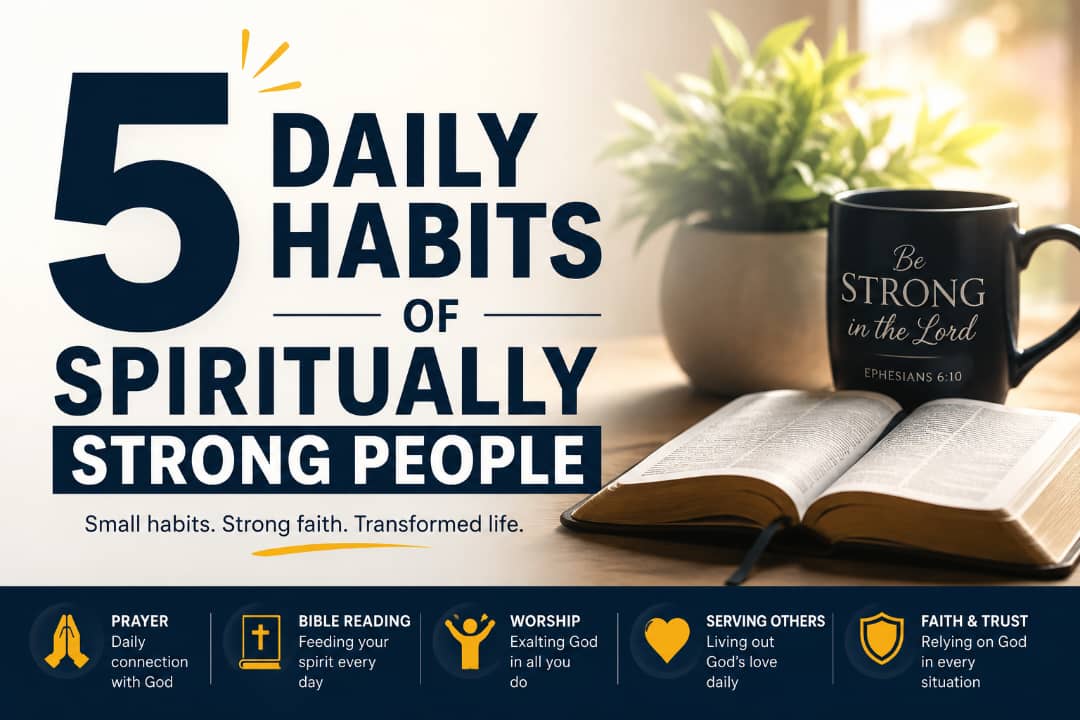
5 DAILY HABITS OF SPIRITUALLY STRONG PEOPLE
5 Daily Habits of Spiritually Strong People is not a list of what perfect Christians do; it is a practical guide to the consistent disciplines that keep ordinary believers growing, standing, and thriving in their faith. Spiritual strength does not happen by accident. Just like physical muscles grow through repeated exercise, spiritual strength is built through deliberate, consistent daily habits. I ALMOST GAVE UP BUT GOD SHOWED UP https://pcainspires.com.ng/i-almost-gave-up-but-god-showed-up/ If you look at the Christians around you who seem unshakeable in their faith, who face storms without crumbling, who radiate peace in chaotic situations, who seem to hear God clearly and live with purpose, they are almost always people of daily spiritual discipline. Here are the five habits that make the biggest difference. Habit 1: They Start Every Day With God Spiritually strong people do not pick up their phone before they pick up their Bible. They do not check social media before they spend time with God. They understand the profound principle found in Psalm 5:3: “In the morning, Lord, you hear my voice; in the morning I lay my requests before you and wait expectantly.” Starting the day with God is not just a religious ritual, it is a strategic decision. When you give God the first part of your day, you invite His wisdom, direction, and presence into everything that follows. You bring your anxieties to Him before they have a chance to grow. You receive His word before the world’s noise can crowd it out. This morning time does not need to be two hours. Even 20-30 minutes of consistent, focused time with God in the morning can completely transform your day and your spiritual growth over time. The key word is consistent. It is better to pray 20 minutes every day than two hours once a week. https://www.bing.com/ck/a?!&&p=85c3c90994c997b6a4f179a7f162d8f99eaee65903c2a70d0807ae13e7914a49JmltdHM9MTc4Nzc4ODgwMA&ptn=3&ver=2&hsh=4&fclid=2366de9e-d8c2-672b-1ff2-cbe9d9766668&psq=HABITS+OF+SPIRITUALLY+STRONG+PEOPLE&u=a1aHR0cHM6Ly93aG9sZW9zb3BoeS5jb20vc3Bpcml0dWFsLWhhYml0cy8 Habit 2: They Read the Bible Daily Spiritually strong people are people of the Word. They do not just read the Bible when life gets hard or when Sunday comes. They feed on Scripture daily, understanding that it is not just a book, it is living, active, and powerful (Hebrews 4:12). Daily Bible reading builds a foundation of truth in your mind that protects you from deception, strengthens you in temptation, and gives you wisdom for decisions. Psalm 119:105 says, “Your word is a lamp to my feet and a light to my path.” You cannot navigate a dark road without light and you cannot navigate life well without the Word. If you do not know where to start, try reading one Psalm in the morning for praise and worship, one Proverb for wisdom, and one chapter from the New Testament for spiritual growth. This simple plan takes about 15 minutes and covers the entire Bible in a year. Habit 3: They Pray Without Ceasing 1 Thessalonians 5:17 gives one of the shortest but most profound commands in the Bible: “Pray without ceasing.” Spiritually strong people understand that prayer is not just a scheduled event, it is a lifestyle. They talk to God throughout the day, not just during designated prayer time. They pray in the car on the way to work. They pray over their meals with genuine gratitude. They whisper a prayer before a difficult meeting. They thank God when they see a sunset. They pray for the person God brings to their mind unexpectedly. This ongoing communion with God keeps their spiritual sensitivity sharp, their peace steady, and their connection with Heaven constant. When trials come suddenly as they often do, these people are not scrambling to find God. They were already in conversation with Him. Habit 4: They Protect Their Mind and Eyes Spiritually strong people are intentional about what they allow into their minds. They understand the principle of Philippians 4:8: “Whatever is true, whatever is noble, whatever is right, whatever is pure, whatever is lovely, whatever is admirable think about such things.” This does not mean they live in a bubble or pretend the world does not exist. It means they are selective. They limit exposure to content that promotes fear, immorality, materialism, or hopelessness. They are careful about how much news they consume, what movies and music they engage with, and what conversations they participate in. Your mind is the gateway to your spirit. What you consistently feed your mind with will eventually shape your beliefs, your emotions, and your actions. Spiritually strong people guard this gateway with great intentionality and without apology. Habit 5: They Stay Connected to a Faith Community Hebrews 10:25 warns us not to give up meeting together and this is not just about church attendance for its own sake. Spiritually strong people stay connected to a faith community because they understand that no Christian is designed to grow alone. We need each other. They are planted in a local church where they worship consistently, not church-hopping whenever the sermon does not suit them. They participate in small groups or Bible studies where they can be known and know others. They have accountability relationships where they can be honest about their struggles. Community provides accountability, support in difficulty, celebration in victories, correction when needed, and the sharpening that comes from iron rubbing against iron (Proverbs 27:17). Lone-ranger Christianity is not biblical and it is not sustainable. Spiritually strong people know this and they prioritize community accordingly. An Additional Habit: They Practice Gratitude Spiritually strong people consistently cultivate a heart of gratitude. They begin and end their days by thanking God, not just for big things, but for small, everyday gifts: health, breath, food, family, another day of life. Gratitude keeps the heart humble, the mind peaceful, and the faith alive. 1 Thessalonians 5:18 says to “give thanks in all circumstances, for this is God’s will for you in Christ Jesus.” Gratitude in all circumstances, even hard ones, is not denial of pain. It is a declaration that God is still good and still in control. Thought. The 5 daily habits of spiritually strong people are
HOW TO STAY STRONG IN FAITH DURING HARD TIMES
How to stay strong in faith during hard times is a question that every honest believer eventually asks. Faith is easy to declare when life is going well, when the bills are paid, the relationships are healthy, the body is strong, and the future looks bright. But what happens to your faith when the diagnosis is bad, the relationship ends, the business fails, or the prayer seems to bounce off the ceiling? This is the real test of faith. And the good news is that God not only understands this test, He has given us specific tools to pass it. Faith was never meant to be a fair-weather virtue. It was designed to be an anchor that holds in the fiercest storms. 1. Remember What God Has Already Done HOW GOSPEL MUSIC BRINGS HEALING TO THE SOUL https://pcainspires.com.ng/how-gospel-music-brings-healing-to-the-soul/ One of the most powerful faith-building practices during hard times is deliberate remembrance. When the Israelites faced the Red Sea with Pharaoh’s army behind them, Moses did not just tell them to pray, he told them to stand still and see the salvation of the Lord. And when they crossed over safely, God instructed them to build memorial stones so they would never forget what He had done. You need your own memorial stones. When your faith is wavering, go back to the times God came through for you. Recall the prayer He answered, the door He opened, the miracle He performed, the person He sent at just the right time. Remembering past faithfulness fuels present faith. Keep a testimony journal. Read it when times get hard. 2. Fill Your Mind With the Word of God Romans 10:17 tells us that faith comes by hearing, and hearing by the Word of God. This means faith is not just given once, it must be continually fed. And the food of faith is Scripture. During hard times, when fear and doubt are loud, the Word of God must be louder. Make a decision to read your Bible daily, even when you do not feel like it. Start with the Psalms for emotional honesty and comfort. Read the Gospels to see Jesus responding to impossibility with authority. Study Paul’s letters to understand how to rejoice even in suffering. The Word of God is alive; it will speak directly into your situation if you open it. https://www.bing.com/ck/a?!&&p=2b3eb88d78d460f0a2696627e8c9ab418a5259fd6d8abec225f995c91030161aJmltdHM9MTc4NzAxMTIwMA&ptn=3&ver=2&hsh=4&fclid=2366de9e-d8c2-672b-1ff2-cbe9d9766668&u=a1L3ZpZGVvcy9yaXZlcnZpZXcvcmVsYXRlZHZpZGVvP3E9aG93K3RvK3N0YXkrc3Ryb25nK2R1cmluZyt0b3VnaCt0aW1lcyZtaWQ9MzAwQjA3MUY5MjBCMEIxREVFODEzMDBCMDcxRjkyMEIwQjFERUU4MSZjaHVybD0mRk9STT1WSVJF 3. Surround Yourself With Faith-Filled People Your environment directly affects your faith level. Proverbs 13:20 says that he who walks with wise men will be wise. During hard times, your circle matters more than ever. Surround yourself with people who remind you of God’s goodness, pray with you and for you, speak life over your situation, and have been through hard seasons and come out on the other side. This does not mean avoiding people who are struggling, it means being intentional about who speaks most consistently into your life. If everyone around you is speaking doubt and fear, your faith will erode. Seek out believers who carry genuine faith and spend time with them, because iron sharpens iron. 4. Worship Before You See the Answer This is the strategy that separates mature faith from immature faith. Anyone can worship after the miracle. It takes genuine faith to worship before it arrives. In 2 Chronicles 20, King Jehoshaphat faced three armies coming against him simultaneously. His response? He appointed singers to go ahead of the army, praising God BEFORE the battle was won. And as they worshipped, the enemy destroyed themselves. When you worship God in the middle of your hardship, declaring His goodness before you see the breakthrough, you are activating a spiritual principle that releases God’s power into your situation. Worship is not just a feeling. It is a weapon. 5. Speak Faith, Not Fear Proverbs 18:21 says that life and death are in the power of the tongue. What you consistently say about your situation shapes both your own faith and the spiritual atmosphere around you. This does not mean pretending everything is fine, it means choosing to declare God’s truth louder than the facts you are facing. Instead of saying “I am going to lose everything,” say “God is my provider and He will make a way.” Instead of “This will never get better,” say “I believe I will see the goodness of the Lord in the land of the living” (Psalm 27:13). Train your mouth to speak faith, especially when everything inside you wants to speak fear. 6. Fast and Pray Some situations require a deeper level of spiritual engagement. Jesus told His disciples that some things only come out through prayer and fasting (Matthew 17:21). Fasting is not just about earning God’s favor, it is also about positioning yourself for greater spiritual sensitivity, focus, and breakthrough. If you are facing a particularly stubborn or overwhelming situation, consider adding fasting to your prayer life. Even one day of fasting per week can significantly deepen your prayer life and accelerate spiritual breakthroughs. 7. Serve Others Even in Your Struggle One of the most counter-intuitive but powerful faith strategies is to serve others even when you are the one who needs help. When you take the focus off your own pain and pour into someone else’s need, something shifts. You begin to see that God can still use you. You are reminded that others are hurting too. And in serving, you often receive the very thing you were looking for, perspective, peace, and sometimes even your breakthrough. Isaiah 58 describes a person who serves others in their fasting and obedience and God’s response is to break their chains, heal them, and answer their prayers. Generosity in your hardest season opens doors that nothing else can open. Thought. How to stay strong in faith during hard times is not about being superhuman or never feeling afraid. It is about making a daily decision to trust God even when it is difficult, to fill your mind with His Word, to surround yourself with faith-filled community, and to
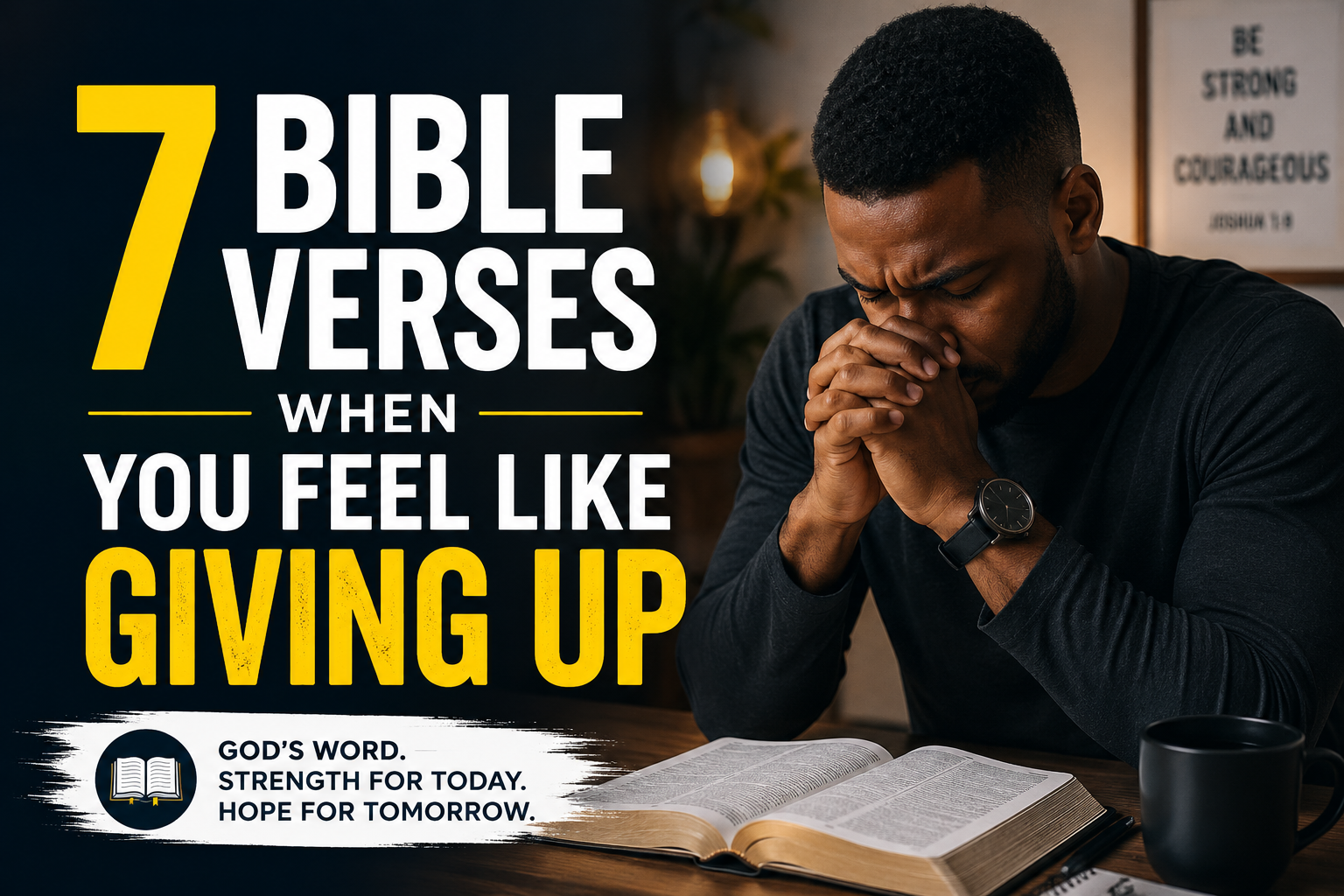
7 BIBLE VERSES WHEN YOU FEEL LIKE GIVING UP
7 Bible Verses when you feel like giving up is a collection of God’s most powerful promises for the moments when life becomes too heavy to carry alone. We have all been there. The point where the struggle has gone on too long, the prayers feel unanswered, the strength is gone, and giving up seems like the only reasonable option. If that is where you are right now, please keep reading. These verses were not chosen randomly. They were chosen because they have carried believers through the darkest seasons imaginable. Let them carry you today. 1. Isaiah 40:31. When You Are Exhausted “But those who hope in the Lord will renew their strength. They will soar on wings like eagles; they will run and not grow weary, they will walk and not be faint.” -Isaiah 40:31 This verse is for the person who has been running on empty for too long. God does not expect you to generate strength from within yourself. He promises to renew it supernaturally, from above. The word “renew” in Hebrew means to exchange. You give God your weakness, He gives you His strength. That is the exchange He is offering you today. Stop trying to push through in your own power. Wait on God and let Him lift you. HOW TO BALANCE FAITH AND CAREER AS A CHRISTIAN https://pcainspires.com.ng/how-to-balance-faith-and-career-as-a-christian/ 2. Galatians 6:9. When You Are Tired of Waiting “Let us not become weary in doing good, for at the proper time we will reap a harvest if we do not give up.” – Galatians 6:9 This verse speaks directly to the person who has been faithful, doing the right thing, praying, serving, trusting and yet seeing no visible results. The promise here is specific: at the PROPER time, you will reap. Not at your preferred time. Not on your schedule. But at God’s perfect, orchestrated moment. The only condition? Do not give up. Your harvest is coming. The field is not empty, it is just not yet the season to harvest. 3. Psalm 34:18. When Your Heart Is Broken “The Lord is close to the brokenhearted and saves those who are crushed in spirit.” -Psalm 34:18 If your pain right now is grief, heartbreak, or a crushed spirit, God is not far from you – He is CLOSEST to you in this moment. This verse is not a general statement about God’s presence. It is a specific, targeted promise for the brokenhearted. Your tears are not invisible to Him. Your crushed spirit is not beneath His notice. He draws near to the broken places. Let Him in. 4. Romans 8:28. When Nothing Makes Sense “And we know that in all things God works for the good of those who love Him, who have been called according to His purpose.” – Romans 8:28 This is perhaps the most misunderstood verse in the Bible. It does not say that all things ARE good. It says God works all things; including the painful, confusing, seemingly disastrous things FOR good. God is a master weaver. What looks like random threads of suffering and confusion on your end is being woven into a beautiful tapestry on His end. Trust the Weaver even when you cannot see the pattern. https://www.bing.com/ck/a?!&&p=fb87dfe188a3a517b570a8afa2caf35ccbdf6b899101093a3afefae95afbbbbcJmltdHM9MTc4NzAxMTIwMA&ptn=3&ver=2&hsh=4&fclid=2366de9e-d8c2-672b-1ff2-cbe9d9766668&psq=BIBLE+VERSES+WHEN+YOU+FEEL+LIKE+GIVING+UP&u=a1aHR0cHM6Ly9vdXJiaWJsZWhlcml0YWdlLmNvbS9iaWJsZS12ZXJzZXMtZm9yLXdoZW4teW91LWZlZWwtbGlrZS1naXZpbmctdXAv 5. Jeremiah 29:11. When You Have Lost Hope “For I know the plans I have for you, declares the Lord, plans to prosper you and not to harm you, plans to give you hope and a future.” – Jeremiah 29:11 God spoke these words to the Israelites who had been in captivity for 70 years. They had lost everything. Their city was destroyed, their temple burned, their families scattered. And yet into that complete devastation, God declared: I still have a plan for you. A plan for HOPE. A plan for a FUTURE. If God could speak those words into a nation’s most devastating season, He is speaking them into yours today. 6. Philippians 4:13. When You Feel Incapable “I can do all this through Him who gives me strength.” – Philippians 4:13 Paul wrote this from prison. Not from a pulpit. Not from a comfortable season of ministry. From chains, in a Roman jail cell, facing possible execution. And yet he declared with certainty: I can do all things through Christ. The “all things” includes what you are facing right now. The impossible situation. The overwhelming responsibility. The terrifying next step. You cannot do it in your own strength and you were never meant to. But through Christ, you absolutely can. 7. Matthew 11:28. When You Are Overwhelmed “Come to me, all you who are weary and burdened, and I will give you rest.” – Matthew 11:28 This is Jesus speaking directly to you right now. Not to the strong, the put-together, the successful but to the weary and burdened. If that is you today, you qualify for this invitation. He is not asking you to fix yourself first. He is asking you to come as you are tired, broken, overwhelmed and He promises to give you REST. True rest. Soul-level rest that nothing in this world can manufacture. Thought. If you are reading these verses at a breaking point, please know this: the enemy wants you to give up right before your breakthrough. The darkest hour is always just before the dawn. You have come too far to quit now. Your story is not finished. God is not done with you yet. Save this post. Come back to it on your hardest days. Share it with someone who needs it today. And remember, the same God who held Paul in prison, who spoke to exiles in Babylon, who sent Isaiah to exhausted people, He is holding you too. Related Posts You Will Love: → How to Stay Strong in Faith During Hard Times https://pcainspires.com.ng/how-to-stay-strong-in-faith-during-hard-times/ → I Almost Gave Up But God Showed Up – A Real Testimony https://pcainspires.com.ng/i-almost-gave-up-but-god-showed-up/ → How to Build a Strong Prayer Life as a Christian https://pcainspires.com.ng/how-to-build-a-strong-prayer-life-as-a-christian/

HOW TO BUILD A STRONG PRAYER LIFE AS A CHRISTIAN
How to build a strong prayer life as a Christian is one of the most important questions any believer can ask. Prayer is not just a religious duty; it is the lifeline of the Christian walk. It is how we communicate with God, receive direction, find peace, and release the supernatural into our natural circumstances. Yet many Christians struggle to maintain a consistent, meaningful prayer life. If you have ever started a prayer routine only to see it fade within days, or if you find yourself going through the motions without feeling any real connection with God, this post is for you. Building a strong prayer life is not about perfection, it is about commitment, strategy, and grace. I ALMOST GAVE UP BUT GOD SHOWED UP https://pcainspires.com.ng/i-almost-gave-up-but-god-showed-up/ 1. Understand What Prayer Really Is Before you can build a strong prayer life, you need to understand what prayer is and what it is not. Prayer is not a formula to manipulate God into giving you what you want. Prayer is not a performance to prove your spirituality. Prayer is not something reserved for people with special gifts or education. Prayer is a conversation with your Heavenly Father. It is as simple and profound as a child talking to a parent who loves them deeply. Jesus modeled this when He taught His disciples to pray: He addressed God as “Our Father”, intimate, personal, relational (Matthew 6:9). When you approach prayer as a conversation with someone who loves you, everything changes. 2. Start Small and Be Consistent One of the biggest mistakes Christians make with prayer is trying to start with hour-long prayer sessions when they have never maintained ten minutes. Consistency is more valuable than duration. Start with 15 minutes every day and actually do it every day rather than two hours once a week. Choose a specific time that works for your lifestyle. Many believers find that morning prayer sets a powerful tone for the entire day. Others prefer the quiet of late evenings. The best time to pray is the time you will actually keep. Create a habit first, then build the duration. 3. Create a Dedicated Prayer Space Where you pray matters more than many people realize. A dedicated, consistent prayer space trains your mind and spirit to enter a posture of prayer more quickly. It does not have to be elaborate; a chair in a quiet corner, a spot in your bedroom, or even a specific place in your car during your commute can become sacred ground. Remove distractions from your prayer space. Silence your phone, close social media tabs, and let the people around you know this is your prayer time. The more intentional you are about the environment, the more focused and fruitful your prayer time will be. 4. Use the ACTS Model of Prayer https://www.bing.com/ck/a?!&&p=8a0ff60e52d03e705dd1304bb6c38a87ab0bf9a908ec41500179f12e11d25b44JmltdHM9MTc4NzAxMTIwMA&ptn=3&ver=2&hsh=4&fclid=2366de9e-d8c2-672b-1ff2-cbe9d9766668&u=a1L3ZpZGVvcy9yaXZlcnZpZXcvcmVsYXRlZHZpZGVvP3E9SE9XK1RPK0JVSUxEK0ErU1RST05HK1BSQVlFUitMSUZFJm1pZD05MDU4NTdCNzQxNUVDMDlERjMxQzkwNTg1N0I3NDE1RUMwOURGMzFDJmNodXJsPWh0dHBzJTNhJTJmJTJmd3d3LnlvdXR1YmUuY29tJTJmY2hhbm5lbCUyZlVDSUwxSDl5bndod2dwTzZuZTJ1QTN1QSZGT1JNPVZJUkU If you are not sure what to pray about or how to structure your prayer time, the ACTS model is a simple and powerful framework used by millions of Christians: A – Adoration: Begin by worshipping God for who He is, not what He has done. Tell Him He is great, holy, loving, and worthy. C – Confession: Come honestly before God and confess any sin, wrong attitude, or area where you have fallen short. Receive His forgiveness (1 John 1:9). T – Thanksgiving: Thank God specifically for what He has done in your life, big things and small things. Gratitude shifts your focus from lack to abundance. S – Supplication: Now bring your requests, for yourself, for your loved ones, for your nation, for others who are hurting. This is where you intercede and petition. 5. Pray the Word of God One of the most powerful ways to strengthen your prayer life is to pray Scripture. Instead of relying solely on your own words, take Bible promises and pray them back to God. For example, instead of saying “God, please protect me,” pray “Lord, Your Word says in Psalm 91 that You will cover me with Your feathers and under Your wings I will find refuge. I stand on that promise today.” Praying the Word increases your faith as you pray, reminds you of God’s promises, and ensures your prayers are aligned with God’s will. You cannot go wrong praying Scripture. 6. Keep a Prayer Journal A prayer journal is one of the most faith-building tools you can add to your prayer life. Write down what you pray for and date each entry. When God answers, write it down. Over time, your prayer journal becomes a personal testimony of God’s faithfulness that will strengthen your faith in dry seasons. Seeing answered prayers in writing removes doubt and builds bold confidence that God hears and responds to your prayers. It is powerful to flip back through months or years of entries and see how God moved. 7. Pray with Others Matthew 18:20 says, “Where two or three gather in My name, there I am with them.” Corporate prayer carries a distinct spiritual power. Find a prayer partner, join a church prayer group, or participate in your church’s prayer meetings. Praying with others keeps you accountable, exposes you to different expressions of prayer, and multiplies spiritual impact. 8. Do Not Give Up When It Feels Dry Every believer goes through seasons when prayer feels dry, distant, or mechanical. This is normal and it does not mean God has left. It is often a season of growth — where faith is being stretched and perseverance is being built. Do not give up. Keep showing up. God honors faithful, persistent prayer (Luke 18:1-8). Thought. How to build a strong prayer life as a Christian is not a mystery, it is a discipline, a delight, and a decision. Start small, stay consistent, pray the Word, and trust that God hears every word you speak. Your prayer life will not transform overnight, but every moment you spend with God is an investment that yields eternal returns. Begin today, not tomorrow, not when things are

HOW GOSPEL MUSIC BRINGS HEALING TO THE SOUL
How gospel music brings healing to the soul is a truth that millions of believers around the world have experienced personally. There is something deeply powerful about worship music, it reaches the parts of us that sermon cannot always touch, that therapy sessions do not always access, and that medicine cannot always cure. Gospel music goes straight to the heart. BIOGRAPHY OF SINACH: NIGERIA’S GOSPEL QUEEN https://pcainspires.com.ng/biography-of-sinach-nigerias-gospel-queen/ If you have ever been in a season of pain, grief, confusion, or spiritual drought and found yourself pressing play on a worship song and somehow felt lighter, stronger, or more hopeful afterward then you already, you are on the right track. Today, we are going to explore why gospel music is one of God’s greatest gifts to the human soul. The Biblical Foundation of Healing Through Music Long before modern science began studying the effects of music on the human brain, the Bible had already established its healing power. In 1 Samuel 16:23, we read that whenever an evil spirit tormented King Saul, David would play the harp and the king would find relief. The tormenting spirit would leave and Saul would feel better. This was not coincidence; it was a spiritual principle at work. Anointed music carries a frequency that disrupts darkness, invites God’s presence, and ministers to the deepest parts of the human soul. The Psalms themselves are songs,150 chapters of musical prayers, laments, declarations, and praises that God preserved for our healing and strength. Gospel Music Releases Emotional Burdens One of the most immediate ways gospel music brings healing is through emotional release. Many people carry heavy emotional burdens, grief from loss, pain from rejection, shame from past mistakes, anxiety about the future. These emotions are often locked inside, with no healthy outlet. When you listen to or sing gospel music that speaks directly to your pain; a song about God’s faithfulness when you feel abandoned, or about His love when you feel unworthy, something shifts. Tears begin to flow. Your chest loosens. You feel seen, understood, and held by an unseen but very real God. Science has also confirmed what believers have known for centuries: music stimulates the release of dopamine and oxytocin in the brain, reducing stress hormones and creating a sense of peace and connection. When that music is gospel infused with the Word of God and the Spirit of God, the effect is multiplied far beyond what natural science can measure. Worship Music Shifts the Atmosphere Gospel music does not just affect the listener inwardly it shifts the environment around them. There is a reason why the atmosphere in a worship service feels different from anywhere else. When Spirit-filled music fills a room, darkness retreats, heaviness lifts, and God’s presence becomes tangible. Psalm 22:3 tells us that God inhabits the praises of His people. When we worship through gospel music, we are literally inviting God to dwell in our space. And where God dwells, healing flows. Depression loses its grip. Anxiety quiets down. Hope re-enters the room. This is why many Christians play worship music constantly in their homes, cars, and workplaces not merely as background noise, but as a spiritual atmosphere they are deliberately cultivating. BIOGRAPHY OF PASTOR CHUKWUEMEKA CYRIL OHANAEMERE https://pcainspires.com.ng/biography-of-pastor-chukwuemeka-cyril-ohanaemere/ Gospel Music Renews the Mind Romans 12:2 tells us to be transformed by the renewing of our minds. Gospel music is one of the most powerful tools for mind renewal available to the believer. When you consistently fill your mind with lyrics rooted in Scripture, declarations of God’s goodness, His power, His promises, and His love; your thought patterns begin to change. Instead of meditating on fear, you meditate on “The Lord is my shepherd, I shall not want.” Instead of rehearsing failure, you rehearse “I can do all things through Christ who strengthens me.” This is not positive thinking this is spiritual transformation through the Word of God set to music. Gospel Music Builds Faith https://www.bing.com/ck/a?!&&p=10dac586efb093a98d5bd02d972df754f34ff32e2d69ff06765e278e82624d68JmltdHM9MTc4NjkyNDgwMA&ptn=3&ver=2&hsh=4&fclid=2366de9e-d8c2-672b-1ff2-cbe9d9766668&psq=HOW+GOSPEL+MUSIC+BRINGS+HEALING+TO+THE+SOUL&u=a1aHR0cHM6Ly9xdWFydGV0Z29zcGVsLmNvbS90aGUtY29ubmVjdGlvbi1iZXR3ZWVuLWdvc3BlbC1tdXNpYy1hbmQtZW1vdGlvbmFsLWhlYWxpbmcv Romans 10:17 says that faith comes by hearing and hearing by the Word of God. When gospel music is scripture-rich, it is literally building your faith every time you listen. Songs like “Way Maker,” “Reckless Love,” “Goodness of God,” and “Great Are You Lord” are not just beautiful melodies they are declarations of truth that strengthen your trust in God. Many believers have testified that it was a specific worship song that pulled them back from the edge of despair. In a moment when they could no longer pray, the song prayed for them. In a moment when their faith was too weak to stand, the music carried them. Practical Ways to Use Gospel Music for Healing Create a healing playlist: Gather your most anointed worship songs and play them during your quiet time, morning routine, or difficult moments. Sing out loud: There is a difference between passively listening and actively singing. When you open your mouth and sing to God, even imperfectly, something powerful is released. Use music during prayer: Let gospel music set the atmosphere before and during your prayer time. It softens your heart and makes it easier to connect with God. Play it in your home: Make your home a house of worship by keeping gospel music playing throughout the day. You are setting a spiritual atmosphere that affects everyone who enters. Thought. How gospel music brings healing to the soul is not just a theological concept; it is a lived reality for millions of believers around the world, including you. The next time you are hurting, overwhelmed, or spiritually dry, do not just scroll through social media. Press play on an anointed worship song and let God meet you there. He promised to inhabit your praise, and He always keeps His promises. Related Posts You Will Love: → Top 10 Nigerian Gospel Songs for Prayer Time https://pcainspires.com.ng/top-10-nigerian-gospel-songs-for-prayer-time/ → How to Build a Strong Prayer Life as a Christian https://pcainspires.com.ng/how-to-stay-strong-in-faith-during-hard-times/ → 5 Daily Habits of Spiritually Strong People https://pcainspires.com.ng/5-daily-habits-of-spiritually-strong-people/

I ALMOST GAVE UP BUT GOD SHOWED UP
I almost gave up and maybe you have been in that place too. That dark, exhausting, hopeless place where you have prayed until you had no more words, cried until you had no more tears, and tried until you had no more strength. The place where giving up feels like the only option left. This is a testimony. Not a perfect story, but a real one. A story about a woman who stood at the very edge of her faith and found that God was already there waiting for her. The Season When Everything Fell Apart https://www.bing.com/ck/a?!&&p=d764a0a4ecffbb64ef07b893ffb7f3760a18c61109a1a2023e7e97b658bb55c2JmltdHM9MTc4NjY2NTYwMA&ptn=3&ver=2&hsh=4&fclid=2366de9e-d8c2-672b-1ff2-cbe9d9766668&u=a1L3ZpZGVvcy9yaXZlcnZpZXcvcmVsYXRlZHZpZGVvP3E9SStBTE1PU1QrR0FWRStVUCtCVVQrR09EK1NIT1dFRCtVUCZtaWQ9RUVCNzJDNjM4Mjk2ODY4Mjg1QkNFRUI3MkM2MzgyOTY4NjgyODVCQyZjaHVybD1odHRwcyUzYSUyZiUyZnd3dy55b3V0dWJlLmNvbSUyZmNoYW5uZWwlMmZVQ3lkNDR6SS0yb0lWYjBMdkpXZkJ4cEEmRk9STT1WSVJF It started slowly, the way most storms do. First, the job loss. After seven years of faithful service, she was made redundant. In a single afternoon, her sense of identity, security, and purpose walked out the door with her office box. Then came the financial pressure. Bills she had never struggled to pay suddenly felt like mountains. She borrowed, she prayed, she fasted. But the months stretched on and the answers did not come. Her relationship broke down. The person she had prayed to marry decided he was no longer interested. The rejection cut deep into wounds she had spent years trying to heal. She lost her mother that same year, suddenly, without warning, without a chance to say goodbye. Grief descended like a thick fog that she could not see through, no matter how hard she tried. “What is the point of praying?” she began to ask. “What is the point of believing when nothing changes?” The Night She Wanted to Stop There was one particular night. She sat alone in her apartment, the lights off, with worship music playing softly in the background not because she wanted to worship, but because the silence was too loud. She opened her Bible out of habit, not faith. She was not reading, just staring at the pages. And then her eyes fell on a verse she had read many times before, Isaiah 41:10: “Fear not, for I am with you; be not dismayed, for I am your God. I will strengthen you, yes, I will help you, I will uphold you with My righteous right hand.” Something broke open inside her. Not in a dramatic, thunderclap way. Just quietly. Like a window cracking open after a long winter. She began to weep not the weeping of despair, but the weeping of someone who has been found. The Morning Everything Shifted Three days after that night, she received a phone call from a contact she had not spoken to in over a year. There was a position, not just any position, but one that combined everything she was gifted in. It paid more than her previous job and offered her the flexibility she had always needed. Two weeks later, she received an unexpected payment that cleared her most pressing debt. A month later, she met someone at her church’s small group, a quiet, God-fearing man who had also been through his own season of loss. None of it came in the timing she had planned. All of it came at exactly the right moment. What She Wants You to Know She asked me to share this story because she knows someone reading this right now is where she was. In the dark. On the edge. Almost done. She wants you to know this: God sees you. Not just your prayers, He sees YOU. Your exhaustion, your confusion, your quiet tears when no one else is watching. He sees it all and He is moved by it. Delay is not denial. The months that felt like wasted time were actually preparation time. God was not silent, He was working. Your breakthrough is closer than you think. The enemy fights hardest right before your blessing arrives. If you are under heavy attack, take that as a sign that something good is near. Do not make a permanent decision based on a temporary feeling. That night she wanted to give up was not the end of her story, it was the turning point. Scriptures to Hold On To Psalm 34:18 – “The Lord is close to the brokenhearted and saves those who are crushed in spirit.” Galatians 6:9 – “Let us not become weary in doing good, for at the proper time we will reap a harvest if we do not give up.” Jeremiah 29:11 – “For I know the plans I have for you, declares the Lord, plans to prosper you and not to harm you, plans to give you hope and a future.” A Prayer For You If this story found you at a breaking point, please pray this with me: “Lord, I am tired. I do not have the strength to keep going on my own. But I choose to trust You even now. You see what I am going through. I believe that You are working even when I cannot see it. Restore my faith, renew my strength, and let me see Your goodness in this season. In Jesus’ name, Amen.” Thought. I almost gave up; but God showed up. And He will show up for you too. Your story is not over. In fact, the best chapter may be the one you are about to enter. Hold on. Keep praying. Keep believing. Your Way Maker is working behind the scenes right now. Related Posts You Will Love: → How to Balance Faith and Career as a Christian https://pcainspires.com.ng/how-to-balance-faith-and-career-as-a-christian/ → 7 Bible Verses For When You Feel Like Giving Up → The Life of Apostle Paul – From Persecutor to Preacher https://pcainspires.com.ng/life-of-apostle-paul-from-persecutor-to-preacher/